Texas Attorney General Sues “TexAM” Over Alleged Illegal Degree Operations

May 19, 2026 – RICHARDSON, Texas — Ken Paxton has filed a lawsuit against an entity operating as “Texas American Muslim University” (TexAM), alleging the organization unlawfully presented itself as an accredited university and misled prospective students about its legitimacy.
According to the Attorney General’s office, TexAM did not obtain the required certificate of authority from the state to operate as a private postsecondary institution. Despite this, the organization advertised bachelor’s and master’s degree programs, promoted a campus location in Richardson, and recruited students both online and internationally.
State regulators had already taken action prior to the lawsuit. On May 6, 2026, the Texas Higher Education Coordinating Board issued a cease-and-desist order, concluding that TexAM was operating illegally and was prohibited from offering degrees. The agency also warned the organization could face civil penalties.
Further complicating matters, TexAM’s nonprofit corporate charter was forfeited in February 2026 and has not been reinstated, raising additional legal concerns about its ability to operate in any formal capacity.
Branding Dispute With Texas A&M
The lawsuit also highlights a naming and branding issue. Officials say TexAM adopted a name “confusingly similar” to Texas A&M University, one of the state’s largest and most recognizable public university systems.
The Texas A&M University System independently issued a cease-and-desist letter demanding that TexAM stop suggesting any affiliation with the institution.
Legal Claims and Potential Penalties
Paxton’s lawsuit names three individuals associated with TexAM—Shahid A. Bajwa, Bilal Piracha, and Arsalan Shahzad—as defendants. The state is seeking:
- A court order to immediately halt TexAM’s operations
- Injunctive relief preventing future violations
- Civil penalties exceeding $1 million under the Texas Deceptive Trade Practices Act and the Texas Education Code
In a statement, Paxton said the case reflects a broader enforcement effort against unauthorized educational providers.
“TexAM has repeatedly disregarded Texas law, misrepresented its authority to grant degrees, and risked deceiving students about its legitimacy,” he said.
Broader Context: Unaccredited Institutions in Texas
Texas, like many states, has strict rules governing higher education institutions to protect students from fraudulent or unaccredited programs. Entities must meet specific standards and receive state authorization before offering degrees.
Cases involving unlicensed or misleading educational providers are not unique to any one community or sector. Regulators periodically investigate organizations of various backgrounds that attempt to operate outside established legal frameworks—particularly in the online education space, where oversight can be more challenging.
Experts note that enforcement actions typically focus on consumer protection rather than cultural or religious identity. Misrepresentation of accreditation status, deceptive marketing, and unauthorized degree offerings are the primary triggers for legal action.
What Comes Next
If the court rules in favor of the Attorney General’s office, TexAM could face significant financial penalties and a permanent shutdown of its operations in Texas.
The case remains pending, and the defendants have not yet publicly responded to the allegations.

May 15th was National Peace Officers Memorial Day

May 18, 2026 – Friday, May 15, 2026, was National Peace Officers Memorial Day. The Hopkins County Marine Corps League Det 1357 gathered on Celebration Plaza, downtown Sulphur Springs, Texas, at 11:00am to honor this solemn event. Judge Brad Cummings sang. Representatives from law enforcement agencies and first responders were in attendance. Below is KSST/Cable Channel 18’s coverage of this event.
Hopkins County Genealogical Society Library to be Closed May 25th

May 18, 2026 – The Hopkins County Genealogical Society announces that their library will be closed Monday, May 25th, 2026 in observance of Memorial Day. The Genealogical Society wishes everyone a blessed weekend. The Hopkins County Genealogical Society Library is located at 611 North Davis Street, Sulphur Springs, Texas.

Wildfires Force Ongoing Closure of Palo Duro Canyon State Park as Crews Battle Dangerous Conditions
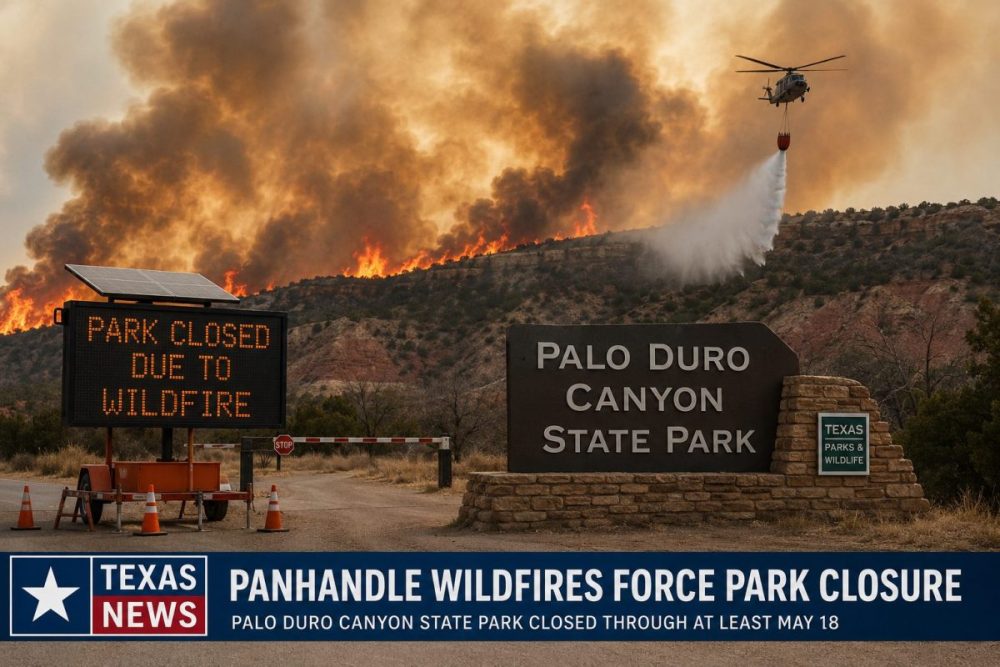
May 18, 2026 — Texas Panhandle – Wildfires sweeping across the Texas Panhandle continue to threaten one of the state’s most iconic natural landmarks, forcing the extended closure of Palo Duro Canyon State Park as firefighters and emergency personnel work to contain rapidly changing conditions.
Fires Trigger Evacuations and Park Closure
The situation began escalating on May 15, when advancing flames from the Hungate Fire and Chocolate Chip Fire approached the park from the west. Officials with the Texas Parks and Wildlife Department (TPWD) ordered a full evacuation of visitors and staff as a precaution.
All park trails were closed immediately, and reservations were canceled, with full refunds issued. Authorities emphasized that the closure would remain in place until conditions are safe for the public to return.
Winds Fuel Flare-Ups
By May 17, conditions had worsened. Strong winds—gusting up to 39 mph—pushed the Hungate Fire closer to the park, triggering new flare-ups and making containment efforts more difficult.
Fire behavior intensified into the evening, prompting officials to extend the closure through at least Monday, May 18. Emergency responders warned that wind speeds were expected to increase further, raising concerns about continued spread.
Ongoing Response Efforts
Texas Game Wardens and State Park Police remain on the ground, assisting local law enforcement and fire crews. Their focus includes evacuation support, perimeter control, and ensuring public safety as conditions evolve.
Firefighters are working under challenging circumstances, with shifting winds and dry terrain complicating containment strategies across the region.
Current Status (as of May 18)
- Park Status: Closed to all visitors
- Fire Activity: Active with ongoing flare-ups
- Primary Threat: Hungate Fire driven by high winds
- Public Access: Restricted until further notice
Officials are urging the public to stay informed through official park alerts and avoid traveling to affected areas.
What Comes Next
Reopening of Palo Duro Canyon State Park will depend on improved weather conditions and successful containment of the fires. Until then, authorities stress caution and patience as crews continue their efforts to bring the situation under control.
Commissioner Miller Praises President Trump and Attorney General Paxton for Launch of Investigation into Meatpacking Industry

AUSTIN, Texas — May 17, 2026 – Texas Agriculture Commissioner Sid Miller on Friday applauded Ken Paxton and the U.S. Department of Justice under President Donald Trump for launching a sweeping antitrust investigation into the nation’s largest meatpacking companies, citing long-standing concerns over market concentration and pricing practices in the beef industry.
The investigation will examine allegations of price fixing, market manipulation, and anticompetitive behavior among the dominant meatpackers, which collectively process the vast majority of America’s beef supply. Industry critics have argued that consolidation has reduced competition, squeezed ranchers, and contributed to higher prices at grocery stores.
Miller described the move as a “tremendous step” toward restoring fairness and transparency in the marketplace, particularly for Texas cattle producers.
“When four companies control more than 85 percent of the beef processing market, that’s not a free market — that’s a stranglehold on America’s food supply,” Miller said in a statement. “For too long, Texas ranchers have been at the mercy of a system that drives down what they’re paid while consumers pay more at the checkout line.”
The commissioner also raised concerns about foreign influence within the industry, noting that some of the largest meatpackers have ties to international ownership. He argued that such dynamics could put American producers at a disadvantage and pose risks to the domestic food supply chain.
“What makes it even worse is that some of these major players are linked to foreign ownership,” Miller said. “Texas ranchers should not be forced to compete in a system where foreign-controlled corporations hold that much power over pricing and supply.”
The Department of Justice has not yet released full details of the investigation but indicated it will focus on whether current market practices violate federal antitrust laws. The probe comes amid increasing political pressure to address consolidation in agriculture and rising food costs nationwide.
Supporters of the investigation say it could lead to stronger enforcement actions, structural reforms, or new regulations aimed at boosting competition. Critics, however, caution that disrupting large-scale processors could have unintended consequences for supply chains and pricing stability.
Miller framed the action as part of a broader push to prioritize American agriculture.
“President Trump and Attorney General Paxton are sending a clear message,” he said. “The days of price fixing, market manipulation, and foreign-controlled dominance over American beef are coming to an end.”
The outcome of the investigation could have significant implications for ranchers, processors, and consumers alike, particularly in states like Texas, which leads the nation in cattle production.

Planning on Planting a Tree? Check out This KSST’s A Second Cup Of Coffee With John Mark Dempsey

May 17, 2026 – If your planning on planting a tree you might want to check out this episode of A Second Cup Of Coffee With John Mark Dempsey. John Mark had another chat with Hopkins County Texas A&M AgriLife Extension Master Gardener Ronnie Wilson, and the two discussed planting trees. They chatted about how to prepare the hole you’re going to plan your tree, what type of soil you should use when planting a new tree, if it’s important to put down mulch, and much more. Be sure to watch the segment below to help you prepare for planting a new tree.

Paris District Road Report for May 18, 2026

May 15, 2026 – Paris — Here’s a look at work planned in Fannin, Grayson, Hopkins, Franklin, Delta, Lamar, Red River, Hunt and Rains Counties for the week starting May 18, 2026. These schedules are subject to change due to weather conditions, equipment failure or other unforeseen issues. Motorists are advised to remain alert and pay special attention to all signs, barricades, and traffic controls, and reduce their speed as they approach and travel through work zones. They should also avoid distractions such as cell phones, eating, drinking, or car audio or navigation systems.
Sherman Area (Fannin, Grayson Counties)
Contacts: Sherman Area Office (903) 892-6529; Grayson Co. Maintenance (903) 893-8831; Fannin Co. Maintenance (903) 583-7566.
Grayson County:
US 75, from the Collin County Line to FM 902. This project will widen the US 75 mainlanes from the Collin County Line to FM 902 to six lanes. The project will also reconstruct the bridge at County Line Road and construct new u-turn bridges in Van Alstyne near Simmons Loop and in Howe south of Hall Cemetery Road. This project will convert the frontage roads from two-way operation to one-way operation. Two lanes on the US 75 main lanes will remain open in each direction during the daytime hours with occasional lane closures during the nighttime period. Watch for lane closures on the frontage roads during construction. A reduced speed limit of 65 mph on the US 75 mainlanes has been set for this construction project.
The frontage roads in Van Alstyne and Howe on both the east and west sides of US 75 from County Line Road (CR 375/Panther Parkway) to Haning St. are one-way roads. The pavement work is completed, and both lanes of the frontage roads are open to traffic except at Bear Rd and Hall Cemetery Rd. The sections at Bear Rd and Hall Cemetery Rd. will have only one lane open. There will be occasional lane closures to install work zone striping & other remaining works. The section of frontage road on the east side of US 75 between Kelly Lane and County Line Road will remain as two-way traffic in order to allow traffic on Kelly Lane to travel to County Line Road.
The US 75 frontage roads in Howe were converted to one-way traffic on February 04. This one-way conversion happened on both the east and west sides of US 75 from Hanning St to FM 902. Occasional lane closures will be in place in order to complete remaining items such as backfill and striping.
US 75, from SH 91 (Texoma Parkway) to US 82. This project will rebuild the US 75 mainlanes from SH 91 to US 82 as well as reconstruct the entrance and exit ramps on US 75. The project will also reconstruct bridges at Taylor Street, Lamberth Street and the US 75 main lanes over US 82 and reconstruct the frontage road intersection at SH 91. A reduced speed limit of 60 mph on the US 75 mainlanes has been set for this construction project. Two lanes on the US 75 main lanes will remain open in each direction during the daytime hours with occasional further lane closures during the nighttime period. Watch for lane closures on the frontage roads during construction.
The US 75 frontage road U-turn at the US 82 frontage road intersection travelling southbound to northbound is closed to traffic to allow crews to continue work on a portion of the new US 75 main lane bridge over US 82. During this closure, traffic is asked to go through the US 75 and US 82 frontage road intersection by making a series of left turns.
US 75 northbound exit ramp to Lamberth Rd. (Exit 63) will be closed from August 20 to May 2026. This is a long-term closure, and drivers should use the adjacent exits.
Lamberth Dr. Eastbound and westbound to be closed from January 17 to September 2026.
US 75 southbound entrance ramp from US 82 is closed.
US 75 northbound frontage road between Loy Lake Rd (Sherman) and FM 691 will be closed from March 30, 2026, at 7:00 am to February 2027. This is a long-term full closure.
US 75 southbound frontage road between FM 691 and Loy Lake Rd. (Sherman) will be closed from April 20, 2026, at 7:00 am to June 2027.
The north-south U-Turn at the frontage roads of US 75 and US 82 intersection will be fully closed during the day from May 01 to May 31 from 9:00 am to 3:00 pm.
The south-north U-Turn at the frontage roads of US 75 and US 82 intersection will be fully closed from May 01 to May 31 from 8:00 am to 5:00 pm.
US 75 northbound frontage road intersection with Lamberth Dr (east side) will be closed for long duration from May 14 to June 15 beginning 8:00 pm.
US 75 southbound mainlanes from Loy Lake Sherman to Travis St (Exit 65) will be fully closed during the nights from May 17 to May 19 from 6:00 pm to 5:00 am. This closure is needed for setting girders.
US 75 southbound mainlanes from Loy Lake Sherman to Travis St (Exit 65) will be fully closed during the nights from May 19 to May 22 from 8:00 pm to 5:00 am. This closure is needed for setting deck panels.
US 75 northbound mainlanes from Travis St. to Loy Lake Sherman (Exit 60) will be fully closed during the nights from May 19 to May 21 from 8:00 pm to 5:00 am. This closure is needed for setting girders.
US 75 main lanes and frontage roads at various locations will be closed for short duration during daytime and nighttime due to mobile operations from April 01 to April 30. These closures are short duration closures that will happen between 8:00 am and 6:00 pm or between 8:00 pm and 5:00 am.
US 75, from US 82 to North Loy Lake Road. This project will rebuild and widen the US 75 mainlanes from four lanes to six lanes as well as reconstruct the entrance and exit ramps on US 75. The project will also reconstruct bridges at FM 691, Iron Ore Creek and Spur 503, and add U-turn bridges at Loy Lake Road in Sherman and Spur 503 in Denison. A reduced speed limit of 65 mph on the US 75 mainlanes has been set for this construction project. Watch for shoulder closures and lane shifts on the mainlanes of US 75 as well as frontage road lane closures within the project. Watch for nighttime lane closures on the northbound and southbound US 75 mainlanes, as crews work to construct the new pavement section.
Westbound Spur 503 is closed to traffic near US 75 as the connecting northbound and southbound frontage roads are being built at the new Spur 503 bridge. Westbound traffic will travel to the intersection of Spur 503 and the northbound frontage road and will go north on the new frontage road to access northbound US 75. Motorists wishing to go south will follow the northbound frontage road to Loy Lake Rd, and take the U-turn and continue south until the next available entrance ramp to southbound US 75.
The U-turn lanes for the US 75 frontage roads at FM 691 are closed to traffic to allow crews to work on constructing the middle portion of the new US 75 bridge over FM 691. During this closure traffic wishing to make a U-turn at the intersection is asked to turn left onto FM 691 and make another left at the next signal light.
The exit ramp from northbound US 75 to North Loy Lake Road in Denison is closed permanently. Travelers who wish to access North Loy Lake Road from northbound US 75 will detour up to Crawford Street, make a U-turn at the Crawford Street intersection, and head south on the frontage road to reach North Loy Lake Road.
US 75, from FM 1417 to SH 91 (Texoma Parkway). A reduced speed limit of 60 mph on the US 75 mainlanes has been set on the mainlanes for this construction project. Watch for shoulder closures and occasional lane closures on the northbound and southbound US 75 main lanes between SH 91 and FM 1417 as crews work on completing the remaining work on this project. Watch for occasional lane closures on the frontage roads between FM 1417 and SH 91.
US 82, from SH 91 to the Fannin County Line. Watch for daytime lane closures on the US 82 eastbound and westbound main lanes as crews work to perform pavement repairs and then a pavement overlay on the surface. Motorists should expect delays during the daytime work hours.
US 75 debris pickup, from Collin County line to Oklahoma State line. Watch for mobile lane closures as workers pick up debris from the roadway every Sunday, Tuesday, and Thursday during the nighttime.
Southmayd Rd at Elba Creek, The bridge at Elba Creek was closed beginning June 25. The bridge replacement is completed and opened to traffic on December 03. Construction crews will continue working on the remaining minor items and motorists are requested to slow down as they drive through the work zone.
FM 697, from east of FM 2729 to US 69, This project will widen FM 697 on each side of the roadway to make the shoulders wider. The project will also safely treat fixed objects and add one course surface treatment on the full width of the roadway. Motorists should expect delays as flaggers direct traffic through the work zone.
Prescott Rd, Southmayd. Contractor will continue performing bridge replacement work on the Prescott Road bridge located between Johnny Watson Road and Jelley Road in Grayson County. Majority of the bridge work is completed, and it was opened to traffic on March 31, 2026. Occasional lane closures will be in place to finish the remaining items of work. Motorists are requested to slow down as they drive through the work zone.
Calf Creek Ln. Contractor will be performing bridge replacement work on Calf Creek Ln bridge located at Calf Creek. The bridge will be closed in both directions beginning March 10, 2026, and will remain closed until July 2026. Road closure signs are installed on the roads leading to the project to inform drivers. Drivers can use Jim Lamb Rd and Whitney Rd. as an alternate route.
FM 922 from Cook County line to US 377. Watch for daytime lane closure as maintenance crews perform level up work on the roads. Motorists should expect delays as flaggers and pilot cars direct traffic through the work zone.
US 82 from FM 901 to FM 1417. Watch for daytime lane closure as maintenance crews perform level up work on the roads. Motorists should expect delays as flaggers and pilot cars direct traffic through the work zone.
US 69 at Iron Ore Creek. Watch for daytime lane closure as maintenance crews mill rough spots on the roadway. Motorists should expect delays as flaggers and pilot cars direct traffic through the work zone.
FM 121 new road. Watch for daytime lane closure as maintenance crews perform edge repair on the roadway. Motorists should expect delays as flaggers and pilot cars direct traffic through the work zone.
Fannin County:
Bonham State Park, Park Road 24. Park Road 24 in Bonham State Park will have daytime lane closures while crews rehabilitate the main road, camping spots and parking lots within the park. Detour routes will be present during construction to allow for the flow of traffic.
FM 274, from SH 78 to FM 1753. Watch for daytime lane closures as crews work to rehabilitate and widen the roadway to an overall width of 26 feet. Motorists should expect delays as signals and pilot cars direct traffic through the work zone.
SH 121 overpass at US 69. The SH 121 overpass at US 69 opened to all traffic on 6/23/2025. Construction crews will continue working on minor items at this location. Motorists should expect delays as there will be occasional daily lane closures through the construction zone.
SH 56 at Hutchins Creek and at Caney Creek. Watch for lane closures as crews perform bridge repair work. The temporary signals are removed. However, motorists should expect delays as there will be occasional daily lane closures through the construction zone.
SH 78 from FM 273 to Oklahoma State line: Watch for daytime lane closures as crews work to rehabilitate the roadway. Motorists should expect delays as signals and pilot cars direct traffic through the work zone.
CR 1202 at Tributary of Brushy Creek. The onsite detour on CR 1202 at Tributary of Brushy Creek has been removed. The new bridge is completed and open to traffic. Traffic is asked to approach the bridge slowly and drive at an appropriate speed through the work zone while crews continue working on finishing the remaining bridge work.
CR 2105. Contractor will be performing bridge replacement work on CR 2105 bridge located at Robert Springs Tributary. The bridge is closed in both directions beginning March 05, 2026, and will remain closed until July 2026. Road closure signs are installed on the roads leading to the project to inform drivers. Drivers can use CR 2110 and CR 2100 as an alternate route.
CR 2410 at Tanyard Creek. Contractor will be performing bridge replacement work on the CR 2410 bridge located at Tanyard Creek. The bridge is closed in both directions beginning January 22, 2026, and will remain closed until May 2026. Road closure signs are installed on the roads leading to the project to inform drivers. Drivers can use FM 100 and FM 2216 as an alternate route.
FM 1553. Watch for daytime lane closure as maintenance crews perform seal coat preparation work on the roads. Motorists should expect delays as flaggers and pilot cars direct traffic through the work zone.
Various locations. Watch for daytime lane closure as maintenance crews perform herbicide application, sign/delineation and mailbox installation along the road. Motorists should expect delays as maintenance equipment travel slowly through the work zone.
Sulphur Springs Area (Hopkins, Franklin Counties):
Contacts: Sulphur Springs Area Office (903) 885-9514; Franklin Co. Maintenance (903) 537-4976; Hopkins Co. Maintenance (903) 885-4031.
Hopkins County: SH 19, from I-30 to Rains County Line. Crews will be installing mailboxes and working on miscellaneous work items.
Franklin County: FM 21, from SH 37 to Titus County Line. Crews will be rehabbing the existing road. Watch for temporary traffic signals within the work area. Expect slower moving traffic.
Hopkins County: SH 19 at US 67. Crews will be working on the pavement joints in the intersection. There will be daily lane closures during the repair process.
Hopkins County: IH 30 from FM 499 to Loop 301. Crews will be performing concrete pavement repairs at night. There will be nightly lane closures during the repair process.
Hopkins County: Broadway Bridge at IH 30. Beginning June 1st, the bridge will be closed to through traffic for 21 days. During this closure the bridge deck will be resurfaced and allowed to cure before being reopened to traffic.
Paris Area (Delta, Lamar, Red River Counties):
Contacts: Paris Area Office (903) 784-1357; Delta Co. Maintenance (903) 395-2139; Lamar Co. Maintenance (903) 785-4468; Red River Co. Maintenance (903) 427-3561.
Lamar County:
BU 271 B, from 18th Street SE to 34th Street SE. Watch for temporary lane and shoulder closures while crews install sidewalk on the north and south sides of the roadway.
SH 19/24, Lamar & Delta Counties: from LP 286 intersection to SH 19. Watch for temporary lane closures and lane shifts while crews resurface the roadway, perform bridge rail upgrades, and bridge maintenance.
US 82, Lamar & Red River Counties: from State Loop 286 in Paris to Bowie County Line in Red River County. Watch for temporary lane and shoulder closures while crews improve drainage structures.
1st ST SW & South Main St., Lamar County: from Hearne St. in Paris to Kaufman ST. in Paris. Watch for temporary lane and shoulder closures while crews install a bike lane and perform pavement and curb repairs.
FM 79, at Little Creek. Watch for temporary shoulder closures and trucks entering and exiting the highway as crews perform bridge maintenance.
BU 82 H (Bonham St.), from Loop 286 to 11th Street NW. Watch for temporary lane and shoulder closures while crews install sidewalk on the north and south sides of the roadway.
BU 271 (North Main St.), from Price Street to Martin Luther King Drive. Watch for temporary lane and shoulder closures while crews install sidewalk on the east and west sides of the roadway.
FM 905, at Big Sandy Creek. Watch for temporary lane and shoulder closures and trucks entering and exiting the highway as crews perform bridge maintenance.
Delta County:
SH 154, from SH 19 to BU 24. Watch for temporary lane and shoulder closures while crews improve drainage structures.
Red River County:
FM 2120, from FM 2573 to SH 37. Watch for temporary lane and shoulder closures while crews rehabilitate the existing pavement and improve drainage structures.
Northeast Texas Trail, Clarksville, Texas. Watch for trucks and equipment entering and exiting streets and highways while crews construct the off-system trail.
Northeast Texas Trail, from BU 82J to Annona East City Limits. Watch for trucks and equipment entering and exiting streets and highways while crews construct the off-system trail.
Northeast Texas Trail, from Annona East City Limits to Bowie County Line. Watch for trucks and equipment entering and exiting streets and highways while crews construct the off-system trail.
BU 82 J, from FM 2825 to High Street (Clarksville). Watch for temporary lane and shoulder closures while crews install sidewalk on the south sides of the roadway.
Greenville Area (Hunt, Rains Counties)
Contacts: Greenville Area Office (903) 455-2363; Hunt Co. Maintenance (903) 455-2303; Rains Co. Maintenance (903) 473-2682.
SH 34, From Traders Road to FM 1570. This project will construct a turning lane, consisting of culvert extensions, roadway widening, overlay, and striping. Work on this project is currently suspended due to utility conflicts. TxDOT is working with utility owners to relocate utilities. Please be aware of workers and watch for work zones when traveling in this area.
FM 2642, from FM 35 to SH 66. The contractor has set work zone signs and barricades. New traffic phase. Please slow down, be aware of workers and watch for work zones when traveling in this area.
FM 512, from SH 34 to FM 118. Barricades and traffic signs are in place. Contractor will be setting signs and mailboxes. Please be aware of workers and watch for work zones when traveling in this area.
SH 276, from FM 751 to CR 3609. The 2.6-mile rehabilitation project will add a center turn lane. The contractor has placed barricades and work zone traffic signs. Contractor is now excavating on the eastbound shoulder. Flagger operations in place while work is being performed. Expect delays in the work zone. Please be aware of workers and watch for work zones when traveling in this area.
FM 36, from US 380 to SH 66. The 6.11-mile project will rehabilitate roadway surface and add safety end treatments. Final pavement surface is complete. Contractor is preparing to backfill edges. Please be aware of workers and watch for work zones when traveling in this area.
FM 816, Bridge Replacement. This project will replace two bridges on FM 816 at Loring Creek. Bridge demolition will begin on May 12th. The road will be closed beginning May 12th, and traffic should follow detour. Please be aware of workers and watch for work zones when traveling in this area.
I-30 Interchange Improvements, from Monte Stratton to FM 1903. Barricades and advance warning signs are in place. Please be aware of workers and watch for work zones when traveling in this area.
I-30 Improvements, from CR2511 to FM 36. Temp wall work is ongoing. The contractor is working in the median and on frontage roads. Expect one lane closures and rolling closures at night. Please be aware of workers and watch for work zones when traveling in this area.
Hunt and Rains Counties:
Hunt County and Rains maintenance crews will be performing pothole repair, roadway sweeping, sign repair work, and mailboxes throughout Hunt and Rains County.
Hunt County maintenance crew will be performing overlay on FM 36 from FM 2194 to FM 1562, and on FM 816 from FM 2194 to FM 1562. Crew will be performing bridge maintenance work in various locations. Maintenance contractors will be performing guardrail repairs at various locations.
Rains County maintenance section will be performing base repairs on FM 47 from SH 276 to Van Zandt County Line. Please be aware of workers and watch for work zones when traveling in this area.
###

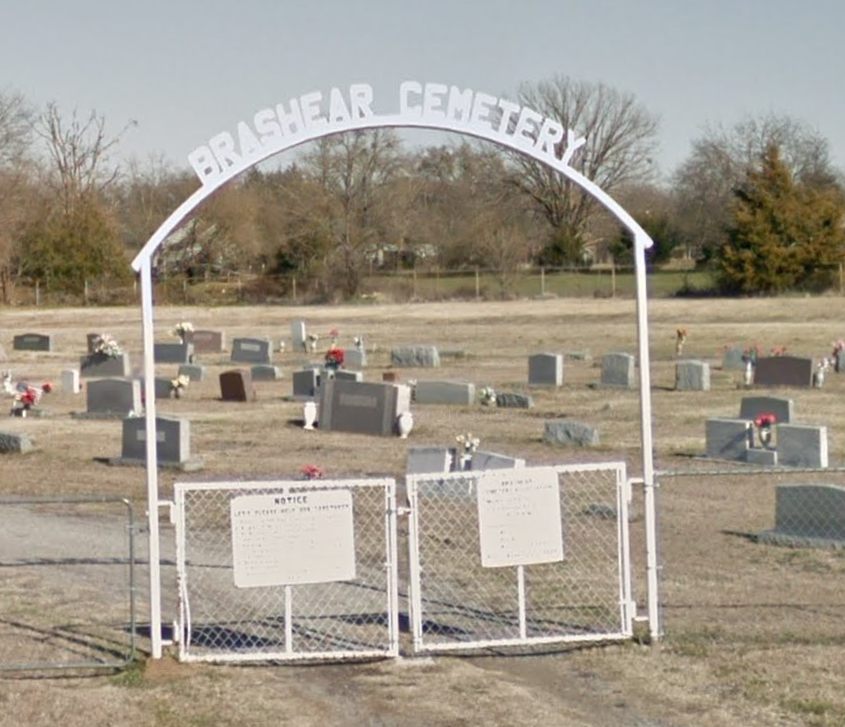
Brashear Cemetery to Hold Homecoming June 6th
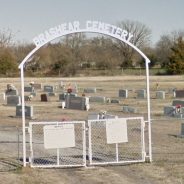
May 15, 2026 – The Brashear Cemetery Annual Homecoming will be held Saturday, June 6, 2026, at the Brashear Baptist Church Fellowship Building. The event will begin at 10:30am. Mr. Tom Mooney will be the guest speaker. There will be a covered dish luncheon afterwards. The public is invited to attend.
Buckle up or pay the Price
May 15, 2026 – Click It or Ticket increased enforcement May 18–31
PARIS – We are Texans. We wear our Lone Star belt buckles with pride, but it’s the buckle in your car or truck that matters the most. It’s the one that can save your life.
That’s why the Texas Department of Transportation (TxDOT) is working with law enforcement and encouraging people to drive like a Texan — kind, courteous and safe — and always buckle up. Remember, Click It or Ticket: every rider, every time.
Lives changed in seconds
Camron Murrell of College Station was just 19 years old when he was killed in a nighttime crash on a back road off Interstate 10 in Liberty County, Texas, in 2020. He was driving with a close friend when he veered off the road and hit a tree.
Camron wasn’t wearing a seat belt, and neither was his passenger. They died instantly.
“Every time he was in my car and wouldn’t put his seat belt on, I would say ‘buckle up!’” said Camron’s mother, Priscilla Wolf. “And it may seem I was on him about it all the time, but he still didn’t listen.”
Seat belts save lives, but only when worn
In 2025, 965 people who died in traffic crashes on Texas roads were not buckled up. While that was a 10% decline from the previous year, which had 1,072 unbuckled fatalities, more lives could have been saved.
- In 2025, there were 6,307 traffic crashes in the Paris District, resulting in 98 fatalities and 387 serious injuries.
- In 2025, there were 83 traffic crashes in the Paris District in which unrestrained occupants sustained fatal or serious injuries. These crashes resulted in 19 fatalities and 71 serious injuries.
“A seat belt can be the difference between walking away from a crash and never making it home, but only if you’re wearing it,” TxDOT Executive Director Marc Williams said. “Whether you’re going just a few blocks or many miles, buckle your seat belt every time, day and night.”
Increased enforcement across Texas
Studies show 1 in 10 Texans do not take the simple step of buckling up — that’s more than 3 million people. Law enforcement will be increasing patrols for two weeks starting May 18, watching out for people not wearing their seat belt.
Texas law requires all drivers and passengers to buckle up or face fines and court costs up to $200. Children younger than 8-years-old must be in a child car seat or booster seat unless they’re taller than 4 feet 9 inches. If they aren’t properly secured, the driver faces fines up to $250 plus court costs.
A campaign proven to save lives
Click It or Ticket is one of the most effective traffic safety initiatives in history. The National Highway Traffic Safety Administration estimates the Texas campaign has saved more than 8,600 lives, prevented 157,000 serious injuries and resulted in $35 billion in economic savings since its launch in 2002.The Click It or Ticket campaign is an important part of TxDOT’s Drive like a Texan: Kind. Courteous. Safe. initiative. Drive like a Texan is about embracing the pride, camaraderie and responsibility of being a Texan on the road. By making thoughtful choices, we can all help keep each other safe. Learn more at DriveLikeATexan.com.
Paxton Targets Over 130 Cities On Tax Transparency Issues

May 15, 2026 – AUSTIN, Texas — Ken Paxton has issued formal notices to more than 130 Texas cities, warning them they are prohibited from increasing property taxes above the no-new-revenue rate after failing to meet state transparency and audit requirements.
The enforcement action follows a sweeping investigation led by the Office of the Attorney General, which reviewed over 1,000 municipalities across Texas. The probe aimed to ensure compliance with Senate Bill 1851, a law passed during the 2025 legislative session that ties a city’s ability to raise property taxes to its adherence to strict financial reporting and audit standards.
Under SB 1851, cities that do not complete required financial statement audits or fail to provide adequate transparency to taxpayers are barred from adopting tax rates that exceed the no-new-revenue threshold. According to the Attorney General’s office, more than 130 cities were found to be out of compliance for the upcoming fiscal year.
Paxton’s letters notify those municipalities that enforcement provisions and potential penalties are now in effect. The cities are prohibited from approving higher ad valorem tax rates until they meet the law’s requirements. Officials emphasized that the current list represents only an initial group, with further determinations expected as the statewide investigation continues.
“I will not allow cities to unlawfully raise taxes on hardworking Texans,” Paxton said in a statement. “Cities cannot fail to abide by state audit requirements without consequences.”
The list of flagged cities spans the state, including communities such as Alpine, Big Spring, Crystal City, Eagle Lake, Livingston, Port Lavaca, Snyder, Texas City, Victoria, and Weslaco, among many others. Some are small rural towns, while others are larger regional hubs, highlighting the broad scope of the compliance issue.
The Attorney General’s office indicated it will continue reviewing municipal records and may take additional action against cities found to be in violation. Local governments are expected to correct deficiencies in their financial reporting if they wish to regain the ability to raise property tax revenues.
The move underscores growing state scrutiny over local taxation practices and signals stricter enforcement of transparency laws affecting Texas taxpayers.

The following list of cities have been sent violation determination letters: Alpine, Aspermont, Baird, Balch Springs, Balmorhea, Bedias, Berryville, Big Spring, Bishop, Blooming Grove, Blue Mound, Briarcliff, Brookside Village, Buffalo Gap, Calvert, Cameron, Campbell, Centerville, Chico, Chireno, Clarksville, Clear Lake Shores, Combine, Corrigan, Crane, Cross Timber, Crowell, Crystal City, Cuero, Dalhart, Danbury, De Leon, Eagle Lake, Elkhart, Eureka, Eustace, Fairfield, Farwell, Flatonia, Franklin, Fritch, Fulton, Gordon, Grandfalls, Gregory, Groesbeck, Groom, Hale Center, Hamilton, Hearne, Hempstead, Higgins, Hillcrest Village, Horizon City, Howardwick, Howe, Huntington, Industry, Ingleside On the Bay, Jewett, Jonestown, Keene, Kemah, Kenedy, Kerens, Kermit, Lamesa, Livingston, Lott, Lumberton, Manvel, Marquez, McCamey, Megargel, Menard, Mertzon, Mexia, Miami, Midway, Miles, Mount Enterprise, Natalia, New Home, New Waverly, Newcastle, Oyster Creek, Paducah, Panorama Village, Pelican Bay, Pleak Village, Plum Grove, Port Lavaca, Quanah, Red Lick, Redwater, Rockdale, Rocksprings, Roma, Rusk, San Elizario, San Felipe, San Perlita, Seabrook, Shepherd, Smiley, Snyder, Somerville, Southmayd, Spring Branch, Spur, Sterling City, Stinnett, Sunray, Surfside Beach, Taft, Tehuacana, Texas City, Texline, Three Rivers, Tiki Island, Tom Bean, Tool, Turkey, Valley Mills, Valley View, Victoria, Weslaco, Weston Lakes, Wharton, Wickett, Wimberley, Wolfe City, Woodloch, Yantis, and Yoakum.